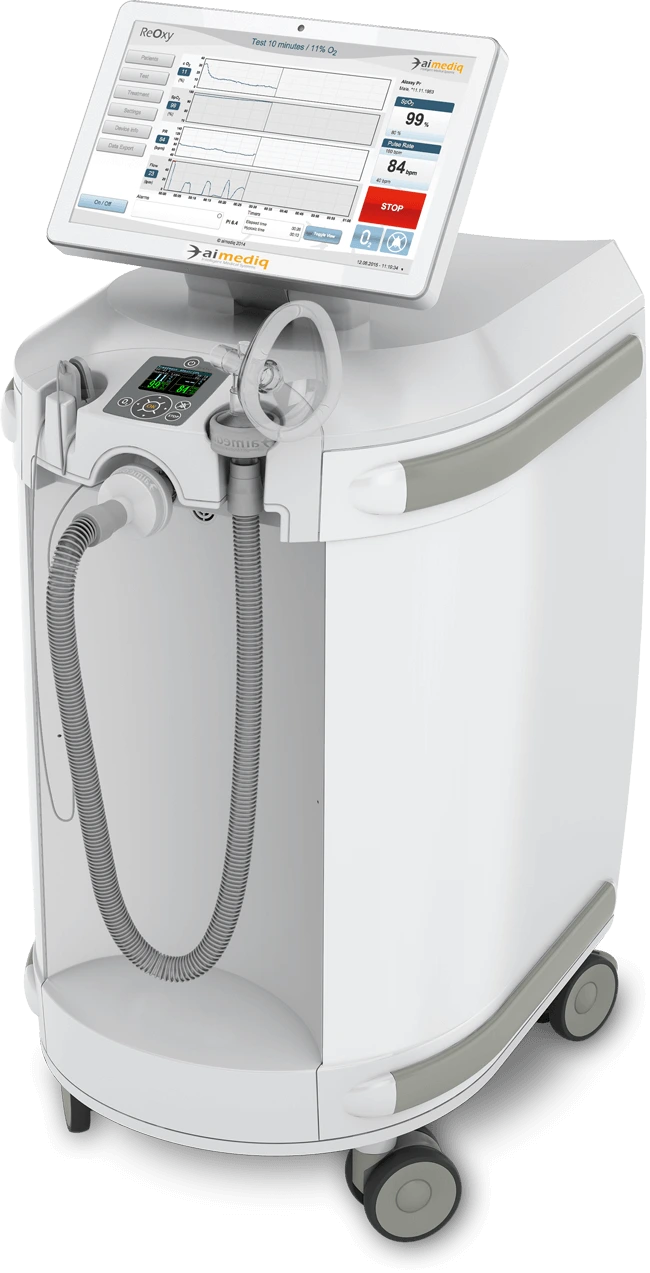
ReOxy in brief: what is the device?
ReOxy® is a medical device designed to deliver IHHT: alternating short phases of breathing gas mixtures with lower and higher oxygen content. The patient breathes through a mask while a sensor measures the body’s response. The system records procedure parameters and supports staff during the session.
ReOxy combines three elements: individual settings informed by a test, ongoing response monitoring and automatic control of gas-mixture changes. This does not mean the device diagnoses patients or replaces clinical judgement. Its use must match the intended purpose and current instructions for the specific model.
What is IHHT, and how does it differ from altitude training?
IHHT stands for intermittent hypoxic–hyperoxic therapy or training. In practice, a person breathes through a mask at rest while a device supplies gas mixtures with different oxygen concentrations. This differs from exercising at altitude or in a hypoxic environment, where the surroundings, physical workload or pressure may change.
IHHT names a method; ReOxy is a specific system for delivering mixtures and monitoring sessions. Keep these concepts distinct: research on another form of hypoxic exposure is not automatically research on the ReOxy device. The device model, population, protocol and clinical question all matter.
How does a ReOxy session proceed?
Details depend on the model, instructions and clinical decision, but manufacturer materials describe several typical stages. Staff first select or complete a patient record and determine whether the procedure is appropriate. A test response to a lower-oxygen mixture is then assessed. The test data help establish individual parameters and alarm limits.
After confirming settings, staff fit the mask and sensor. The device alternates hypoxic and hyperoxic mixtures while monitoring oxygen saturation and pulse. Phase changes take place within the procedure parameters and the patient’s response. Staff remain responsible for supervision, alarms and assessment. Depending on the configuration, the system can save or export a report.
The manufacturer gives a general procedure duration of about 30–60 minutes. This is indicative product information, not a universal session time or a recommendation for any particular person.
Hypoxia and hyperoxia: two phases with different roles
Hypoxia means a lower oxygen concentration in the supplied mixture than in ordinary air. In ReOxy, its brief phase is part of a controlled exposure, not a do-it-yourself endurance test. The device then switches to hyperoxia, a mixture enriched with oxygen. The manufacturer describes this phase as accompanying oxygen saturation recovery before another cycle.
The manufacturer’s general device description gives 10–14% O₂ for the hypoxic mixture and 30–40% for the hyperoxic mixture. Another manufacturer page gives 9–15% and 30–35%. These differences are a reason not to treat figures in an article as settings for use. Appropriate values depend on the model and procedure; the current instructions and clinical staff take precedence.
What is SRT® technology?
SRT® is the manufacturer’s feedback-control technology. In simplified terms, the system observes measured patient parameters and uses them to control the procedure. Rather than assuming everyone responds identically to the same mixture, the software uses test data and ongoing measurements.
This is intended to support individualised exposure and mixture switching against set thresholds. Automation does not mean autonomous treatment or guarantee a particular outcome. A physician and trained staff remain responsible for assessment, supervision and interpretation.
What does ReOxy measure during a session?
The manufacturer lists monitoring of blood oxygen saturation (SpO₂), pulse rate (PR) and oxygen in the supplied mixture. The system displays current and programmed parameters, indicates the operating phase and records measurement trends. The manufacturer identifies Masimo SET pulse oximetry for SpO₂ and pulse measurement.
Pulse oximetry provides information about specific parameters, not a complete picture of health. Readings can depend on measurement conditions and signal quality; staff interpret them in the context of the patient and device instructions. The display, alarms and session record support operation but do not replace clinical assessment.
What does research on IHHT show?
Studies investigate IHHT in different, carefully defined populations. A 2018 single-centre randomised trial by Tuter et al. included 127 patients awaiting coronary artery bypass surgery. It assessed markers including troponin I and lactate after surgery. The authors reported promising marker results while calling for larger trials with clinical endpoints. This concerns a specific perioperative protocol; it does not show that ReOxy has the same effect in every setting.
A 2024 controlled pilot by Doehner et al. enrolled 145 people with long COVID in inpatient rehabilitation. Participants received IHHT alongside rehabilitation or the standard rehabilitation programme. The authors reported improvement in selected functional outcomes in the IHHT group. The study was open-label and non-randomised, so between-group differences require cautious interpretation. It was not a study of military personnel or operational performance.
Research conclusions depend on the population, group allocation, comparator, sample size and whether the outcome was clinical or a surrogate marker. Published research does not establish effectiveness for every indication. Read full papers and their limitations rather than relying only on marketing summaries.
What has not been demonstrated?
The cited publications do not justify promises of disease prevention, rejuvenation, increased energy for every patient, or improved athletic or military performance. Findings from one protocol should not be transferred to another population or use. Such claims would require evidence directly addressing the relevant population, purpose and method.
A responsible description separates three questions: what the device technically does, what the specific model’s documentation permits, and what research has demonstrated. These are related, but they are not interchangeable.
Who may be considered for ReOxy?
Eligibility is not determined by a device description, advertisement or online form. A medical assessment should consider current health, indications, contraindications and the model’s documentation. Consult the current instructions for the full list of restrictions and assessment requirements.
ReOxy should not be used independently at home or programmed from information in an article. It must be used in its intended setting, under trained staff supervision and according to a physician’s prescription. If in doubt, speak with a physician or a provider familiar with the device documentation.
ReOxy versus a hyperbaric chamber, oxygen concentrator and oximeter
ReOxy delivers different breathing mixtures through a mask and controls their changes during an IHHT procedure. It is not a hyperbaric chamber, where treatment takes place under increased pressure. Nor is it an ordinary oxygen concentrator or a standalone pulse oximeter.
Although the system uses a sensor and gas-delivery components, its function and intended purpose are defined by the manufacturer’s documentation. Medical devices may share components without being interchangeable. Indication, model, accessories, staff and care workflow all matter.
How should safety and contraindications be assessed?
Safety depends on appropriate assessment, use within the intended purpose, a properly functioning device and following procedures. The manufacturer describes automatic mixture switching, alarm thresholds, audible and visual alarms, and a valve that can supply ambient air. These are design features, not a promise of zero risk.
We do not publish a universal contraindication list because it must be checked in the current instructions for the specific model. Before a session, patients should share relevant health information with their physician, and staff should know how to respond to alarms or an unexpected reaction.
Frequently asked questions about ReOxy
Is ReOxy the name of the method? No. ReOxy is a device; IHHT is a method involving alternating exposure to mixtures with lower and higher oxygen content.
Does ReOxy operate automatically? It controls mixture changes using settings and measurements, but the procedure requires assessment and clinical supervision.
How long is a session? The manufacturer gives a general range of 30–60 minutes; actual duration depends on the model, protocol and clinical decision.
Are the oxygen figures settings for every patient? No. They are ranges from general manufacturer materials. Staff determine individual parameters based on testing, instructions and assessment.
Can ReOxy be used without a physician? It should not be. The manufacturer specifies use according to a physician’s prescription and the instructions for use.
What should you check before discussing the device?
A provider considering ReOxy can begin with practical questions: which model is offered and which instructions apply; what space and staffing are required; what training and service are included; how records are maintained; what the full implementation cost is; and which clinical need the institution wants to assess.
Request current documentation, delivery scope, service and training terms, and discuss legal and operational requirements with people responsible for care, procurement and safety. This helps assess fit without assuming the technology suits every institution.
In summary: what does ReOxy mean?
ReOxy is a medical device for supervised IHHT. It alternates mixtures with lower and higher oxygen content, measures selected patient parameters and uses feedback to control the session. It should therefore be assessed in terms of its technology, documentation, patient assessment, workflow and quality of evidence.
If you represent a healthcare institution and would like to discuss operational requirements, a specific model or training, prepare your questions and contact the ReOxy team. An information meeting does not replace clinical assessment or create an obligation to purchase.
Sources and further reading
1. www.aimediq.com / general-description2. www.aimediq.com / reoxy-treatment3. www.aimediq.com / srt-technology4. www.aimediq.com / clinical-evidence5. pubmed.ncbi.nlm.nih.gov / 304879816. pubmed.ncbi.nlm.nih.gov / 39559920Information only. This does not replace the instructions for use or individual medical advice.