Medicine first. Military context second.
ReOxy is a medical device for individually monitored IHHT respiratory therapy. For a military healthcare institution, appropriate starting points include rehabilitation, clinical care and a well-designed technology assessment. A service member’s status does not change the device’s intended purpose or establish improved readiness, combat performance or tolerance to oxygen deprivation. Any use must remain within the current instructions for use and applicable clinical requirements.
What happens during a session?
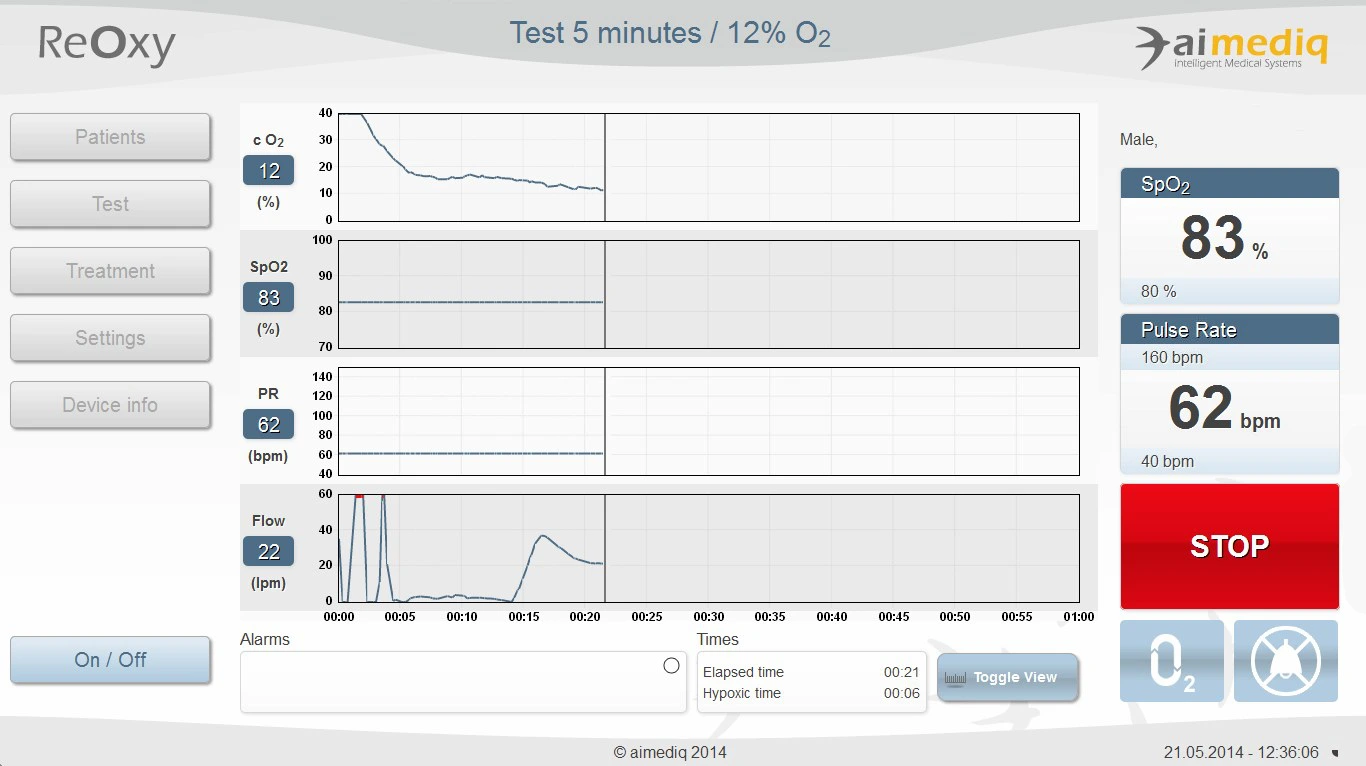
The device alternates between gas mixtures with reduced and increased oxygen content. The manufacturer’s general description gives ranges of 10–14% and 30–40% O₂ respectively; these are not settings for self-directed use. A test precedes the procedure, and the system uses SpO₂ and pulse measurements to control phase switching for the individual. Staff supervise the patient, parameters and alarms. Settings, patient assessment and procedure duration follow the instructions for the specific model and the physician’s decision.
What the research says — and where its conclusions stop
A 2022 systematic review covering publications through September 2021 identified eight human IHHT studies. Populations included older adults, people with cardiovascular or metabolic conditions, and young athletes with overtraining syndrome. The authors called for further research and cautious interpretation. A later controlled pilot in long-COVID rehabilitation involved 145 patients and a specific rehabilitation programme. These are relevant clinical contexts, but they are not studies of service members and do not establish operational performance benefits.
Where might an institutional discussion begin?
A military healthcare system could first assess whether supervised respiratory therapy fits a defined clinical pathway, such as facility-based rehabilitation, and whether a team can provide patient assessment and oversight. A second area may be a formal technology assessment or clinical study with a clear question, appropriate oversight and required approvals. A third is procurement planning: documentation, training, service, space and workflow. Each direction requires its own evaluation; none is a recommendation for field use.
Conditions for responsible evaluation
Before a discussion, establish who owns clinical decisions; which population and purpose are being assessed; which documents and instructions apply to the supplied model; how staff will be trained; how alarms and adverse events will be handled; and which approvals are needed if research is planned. Do not use the device outside its intended purpose and instructions, or treat general website information as a therapy protocol.
A question for the next conversation
The best next step is not a promise of an outcome, but a well-framed question: is there a defined clinical need in which supervised IHHT can be safely assessed within its intended purpose? The interactive brief above helps collect institutional requirements. You can keep the checklist without sharing contact details, or continue to a discussion with the ReOxy team.
Sources and further reading
1. www.aimediq.com / general-description2. pubmed.ncbi.nlm.nih.gov / 356392113. pubmed.ncbi.nlm.nih.gov / 395599204. pubmed.ncbi.nlm.nih.gov / 17805096Information only. This does not replace the instructions for use or individual medical advice.